
Noncommercial Shrimp Season Reduced, Commercial Season Closed for 2026
Managers Implement Strict Limits in Conservation Attempt
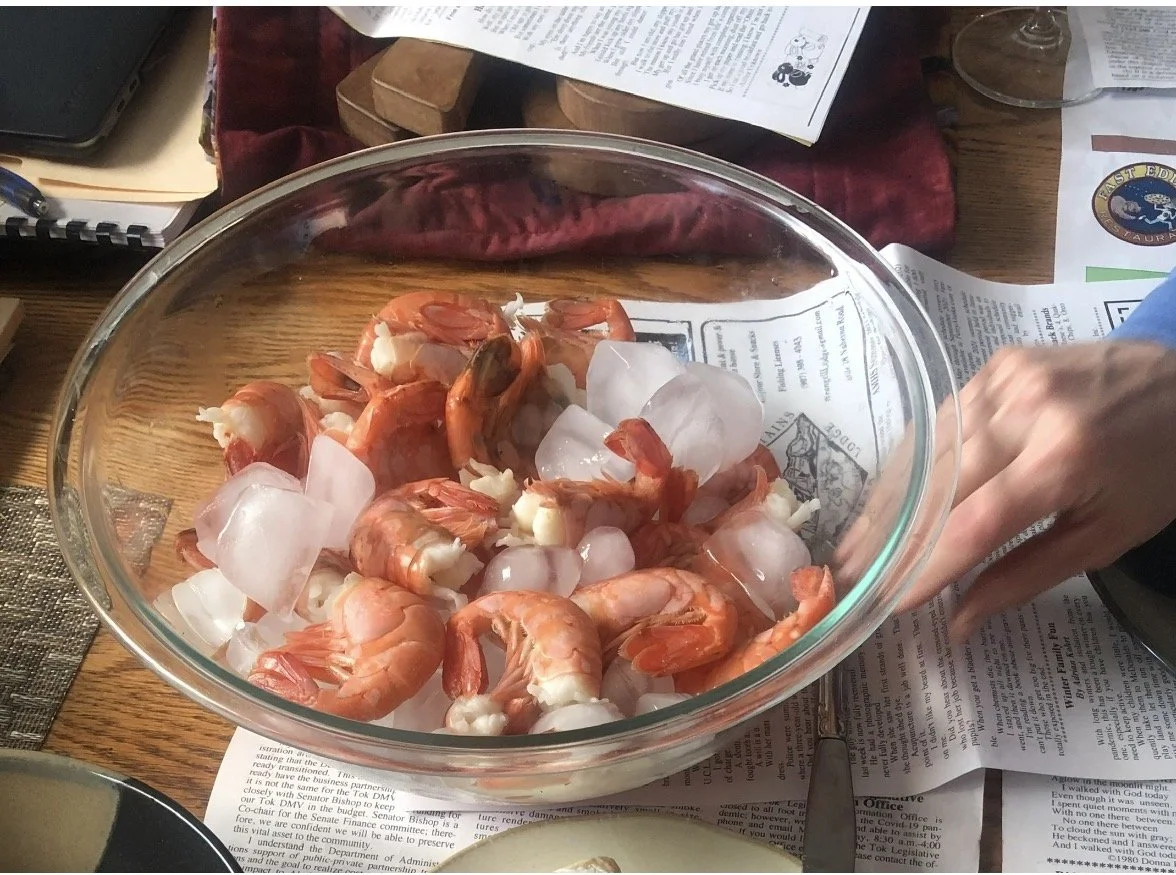
Alaska spot prawns on ice. (Photo by Allison Sayer)
By Allison Sayer
TNews Staffwriter
On February 26, the Alaska Department of Fish and Game (ADF&G) announced the noncommercial (sport + subsistence)spot shrimp fishery would be open from May 1 through June 8, and fishers would be limited to two pots. This is over six weeks less than last year, and almost four months shorter than the 2024 season.
The guideline harvest limit (GHL) in the 2026 noncommercial fishery is 29,782 pounds. Managers determine the GHL as a proportion of the estimated population, which has declined each year since 2021. Pot and season limits are then implemented based on the limit.
The 2025 GHL was 54,311 pounds of shrimp, and the season was open May 1 though July 31 with two pots. During 2025, fishers exceeded the GHL, catching 60,234 pounds. The noncommercial fishery catch has exceeded the GHL for seven of the past seventeen seasons, despite managers implementing pot and season limits.
ADF&G commercial and sport fishery staff hosted an online meeting February 12 to discuss shrimp research and take public questions and comments. According to Area Management Biologist Brittany Blain-Roth, about 130 people tuned into the meeting.
One bright spot presented by Fisheries Biologist Alissa Cole was the 2025 shift in commercial and noncommercial season opening days from April 15 to May 1 reduced the percentage of egg-bearing females taken in the harvest- from 36% of the fishery to just 5%. Presumably, the later date gave most females time to release their eggs before being harvested.
Cole shared population estimates come from an annual survey that has been performed in October throughout Prince William Sound since 1992.
Assistant Area Management Biologist Donald Arthur stated that during the period between 2000 and 2021, the shrimp population increased overall, with some fluctuations from year to year. During surveys between 2010 and 2020, staff observed all age classes doing well and surviving into the next year, even “dying of old age.” Arthur stated that while the team imagines this was due to a favorable environmental factor, they do not know what the factor is.
After another year of abundance in 2021, the estimated population dropped by over 25%- from over four million pounds in 2021 to just over three million in 2022. It has continued to decrease annually, now estimated at about 1.1 million pounds.While Arthur acknowledged survey data can be impacted by gear or weather, he felt confident the overall trends in the data were a true reflection of population patterns.
There were no members of the public in attendance who testified that their observations were different from trends described by ADF&G staff.
A few days after the meeting, I spoke with Valdez resident David Rentel. Rentel started commercial fishing for shrimp in 1979, and has fished most of the years the fishery has been open since. He said his experience in recent years is consistent with the trends described by managers. “We have seen the numbers go down and the size go down. We’re not getting as many big shrimp.”
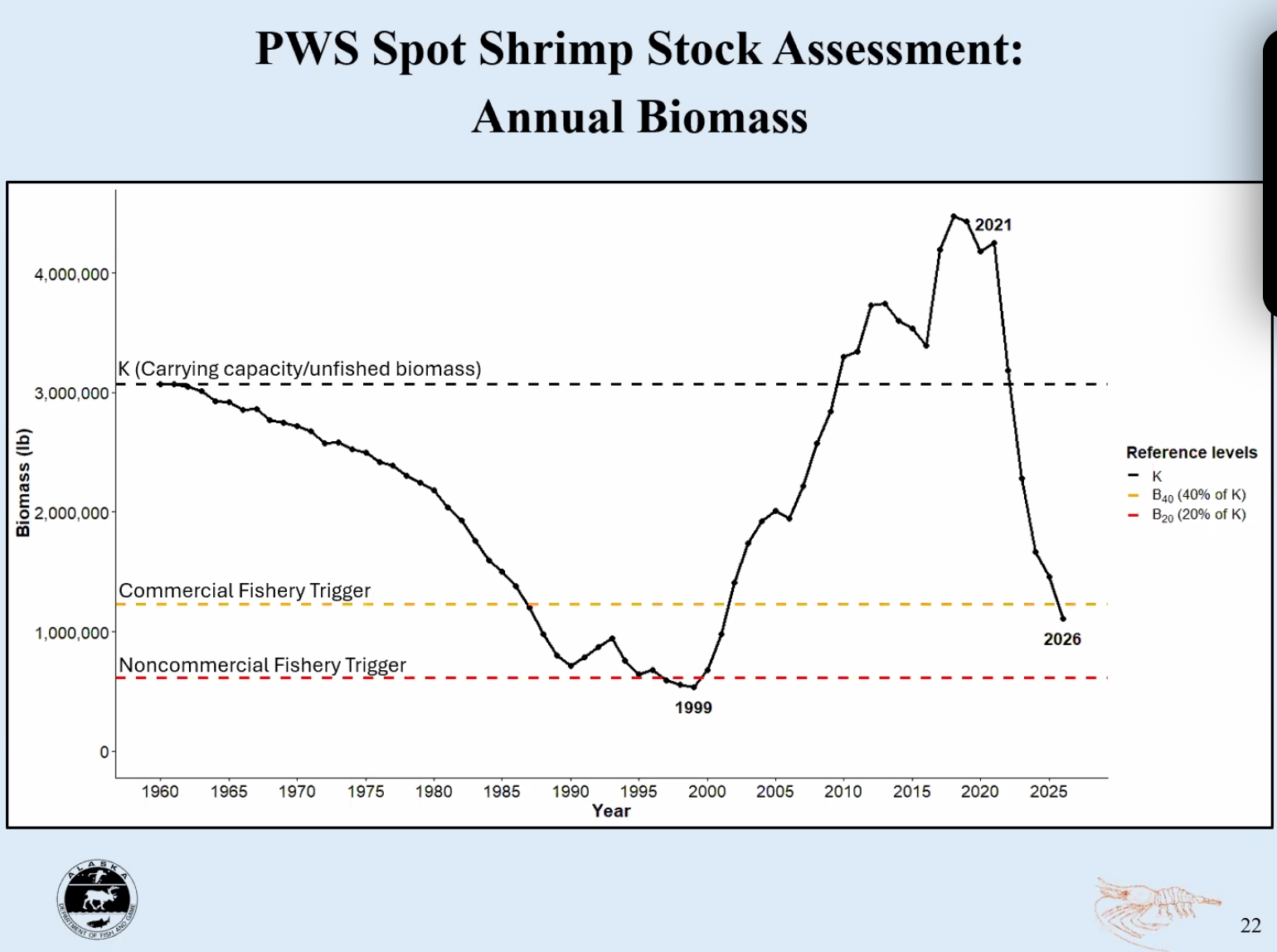
Estimated spot shrimp biomass in Prince William Sound. The black line at the top is an estimate of what the population would be with no fishing pressure. The yellow dashed line is the threshold determining whether to open the commercial fishery. The red line is the threshold for the personal use fishery. The annual shrimp survey began in 1992. The Exxon Valdez Oil Spill occurred in 1989. Figure created by ADF&G.
Is Overfishing To Blame?
During the February 12 meeting, several ADF&G staff members stated they could not identify the cause of the population drop.
Survey data show a decline in the population’s proportion oflarge individuals, sometimes a sign of overfishing. This decline is especially troubling in shrimp because individuals start their adult lives as male, with larger individuals becoming female. However, staff also observed poor recruitment of juvenile shrimp to adulthood last fall, which would not be directly affected by fishing.
Arthur stated that staff also have no explanation for why the shrimp population increased dramatically from 2010 to 2020, even as fishing pressure increased. The commercial fishery re-opened in 2010, after many years of closure.
Other potential factors that could be impacting the shrimp are competition for food, predation, a failure lower in the food chain, or environmental factors such as temperature or currents.
During the February 12 meeting, a participant asked whether trawling in state waters just outside of Prince William Sound could impact the shrimp. Arthur replied there was no known impact, adding the trawling presence has remained constant while the shrimp population has fluctuated.
Are there other ways to manage the fishery?
Pot and season limits are currently ADF&G’s only tools to reduce fishing effort for shrimp in the noncommercial fishery. Limiting shrimp by the pound could cause excess shrimp to be thrown back. Their chance of survival after being thrown back is not well understood.
Blain-Roth stated that as someone who enjoys shrimping on her own time, she would find it hard to imagine fishing with just one pot. Two pots seems to be the lowest feasible limit.
Commercial fishery participants are required to report their catch daily, and managers adjust the season accordingly. Noncommercial fishers have the option to report online during the season, but are not mandated to report their catch until after the season is over.
Blain-Roth stated it would be challenging to track thousands of noncommercial fishers in-season compared with commercial fishers, who numbered 79 in 2025. She also stated the Department lacks the budget and the enforcement capabilities to mandate in-season reporting. However, she stated she is open to “explore” in-season reporting despite these challenges.
ADF&G announced on February 5 that the commercial season would not open.
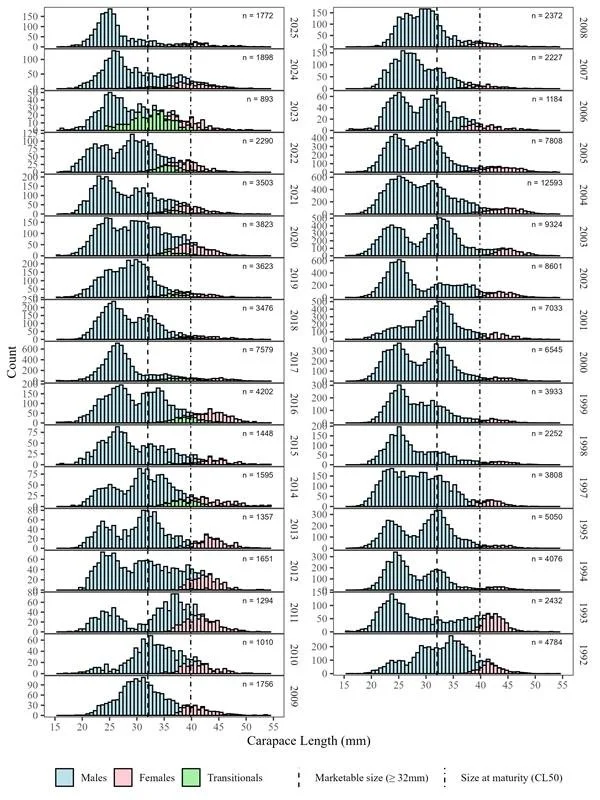
Proportion of carapace length throughout the history of the ADF&G Prince William Sound spot shrimp survey. The first dashed vertical line at 32mm is the size of marketableshrimp. The second dashed vertical line is at 39mm, whenthere is a 50% probability the shrimp will be mature. Males are shown here in blue, females in light pink and transitional in green. Adult shrimp begin their lives as male. The individuals who attain large size as they age become female. Figure created by ADF&G
Update: This article has been corrected from a previously published version. The fishery was described as "personal use" in the original version, when it should have been described as "noncommercial."