Beluga Whales Last Refuge: a Library and A Quiet Bay
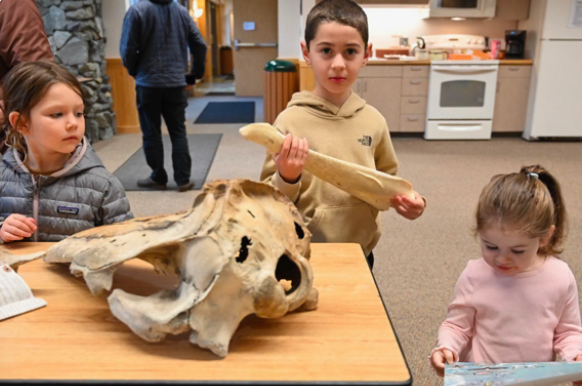
Lucas and Teia Trocin, center and right, check out a beluga jawbone and sticker map while another beluga enthusiasts looks on. (
By Soren Wuerth
TNews Editor
Displayed on a screen in a community hall, they are a species explained.
Then the sound "beluga" whispers past a table with a skull displayed, whooshes by children examining sticker maps crowded with marine busyness, follows a glacial creek to Turnagain Arm, touches a bore tide surfer, passes Bird Point and another point that bears its name.
Beluga sounds as pods swimming south down Cook Inlet.
They surface alongside a hissing highway and beneath a roar of airplanes. They pass oil drilling platforms, container ships and fishing sites.
Around 300 white whales, all that are left of a population once numbering 1,300, bob and dive and glide to a winter sanctuary—quiet and undisturbed Tuxedni Bay, where they will spend winter.
For as many as eight months they will loll and whistle, chirp, squeal and grunt to one another. They will eat, possibly, halibut, smelt and flounder. They might frolic near Magnetic Island with its 3,500-year-old hearths of stone or surface near rock pictographs depicting Alutiiq shamans and whales.
Tuxedni Bay is shallow and safe from killer whales. It's one of the "most undisturbed sections of their critical habitat" in Cook Inlet, say researchers.
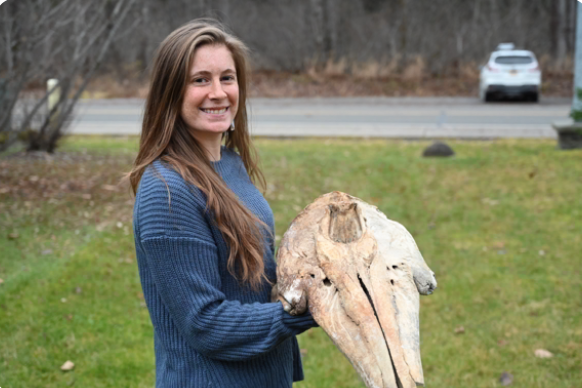
Beluga Monitoring Program coordinator Michelle Trifari displays a beluga skull Saturday in front of Girdwood's Community Hall. (Photo by Soren Wuerth)
One hundred miles from Anchorage, Tuxedni Bay is not only the Cook Inlet belugas' winter foraging refuge, but the site of a proposed port to ship out gold ore from a deposit called "Johnson Tract".
The company HighGold plans to build a runway, road, tunnel and port to transport ore containing gold and other minerals from Cook Inlet Region Inc. land in Lake Clark National Park and Preserve.
Environmental groups have petitioned for protections and filed lawsuits to protect the belugas, bears, endangered seabird colonies and traditional subsistence fisheries from the threat of prey disturbance, acid drainage, noise and habitat damage.
"All About Belugas"
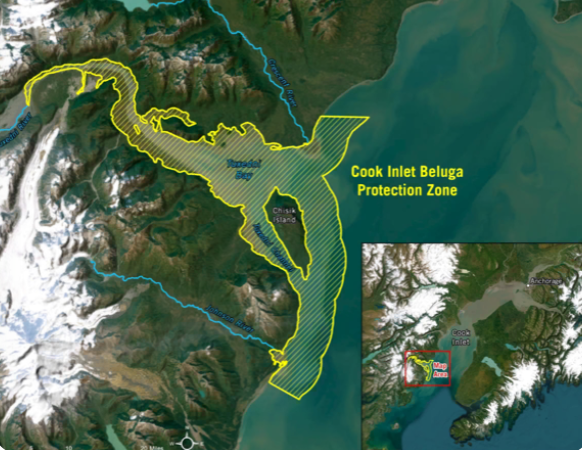
Cook Inlet Beluga Tuxedni Bay Protection Zone. (Graphic courtesy of Kara Clauser, Center for Biological Diversity).
Back in Girdwood, Michelle Trifari, a program coordinator for the Beluga Monitoring Program, introduced the marine mammals to an audience of about two dozen adults and children.
Her program, contracted through the National Oceanic and Atmospheric Administration, manages a shore-based monitoring program to station volunteers at road-accessible sites along Cook Inlet, from Ship Creek in Anchorage, to Kasilof River on the Kenai Peninsula.
And though her's is not an advocacy position, Trifari is an expert on the mysterious "canary of the sea".
Her presentation, hosted by Girdwood's Gerrish Branch Library, delved into a plethora of facts about the animals.
Belugas can grow to 16 feet, weigh up to 3,000 pounds and live to 90. They can hold their breath for up to 20 minutes. They are extremely social animals, gray until they are 14 years old or so, and can wag and nod their bulbous, melon-shaped heads.
Due to declining numbers of belugas, Alaska Natives voluntarily stopped hunting them in 1999. It was thought subsistence hunting was responsible for a drop in populations, but managers were wrong.
Belugas, which, Trifari said, take a long time to reproduce, didn't rebound after the cessation of huntings.
Scientists are not sure why.
To gather more data, Trifari's program and others are collecting information on whales with methods such as acoustic monitoring, DNA sampling and visual surveys. These involve aircraft, boats and shore-based observations.
The broad-based approach is demanded by a concern for the whales, whose decline hasn't been explained. Cook Inlet belugas, one of five distinct groups in Alaska coastal waters, were listed as endangered in 2008.
They are one of nine "species in the spotlight", animals nearing extinction to which NOAA gives priority attention.
"If the population disappears in Cook Inlet, it is unlikely another [group of belugas] would colonize the area," Trifari said, since the inlet is unique with a difficult environment.
So, for now, people concerned about belugas can help with monitoring as "citizen scientists".
Along the Arm there are three monitoring locations: Beluga and Bird points and a wayside at the mouth of Twentymile River.
The Beluga Monitoring Project partners with various organizations, such as the Sierra Club, the Alaska Wildlife Alliance and Defenders of Wildlife to host two-hour monitoring sessions.
So far, there's been 3,768 session hours and 13,717 beluga sightings, she said.
"The data collected informs conservation management efforts and research to help recover this species," Trifari said.
After the presentation, children explored tables of marine mammal tusks, hides and skulls.
In the not-too-distant future some may point at the sleek curves of white flashing above silty gray Turnagain Arm and wonder. Others may peer through binoculars and fill out data sheets.
"We are so lucky to have this amazing species right out here in your backyard," Trifari said.
As for the belugas, they are likely in Tuxedni Bay, or on their way there, where five researchers have been working on a multi-year grant to determine how undersea noise might be "masking" communication among the highly social and vocal belugas.
"They use acoustics to find prey, navigate their environment, avoid predators and maintain group cohesion," a NOAA article explained. "For Alaska’s critically endangered Cook Inlet beluga population, these crucial communications may compete with a cacophony of noise from human activities."
“The core critical habitat for these whales is a very noisy area. Commercial shipping, an international airport, military operations, and gas and oil exploration are all concentrated there,” researcher Arial Brewer said in the article.
For more information on NOAA's monitoring program, go to akbmp.org