FVCS led the state with Alaska’s first and only snow classic
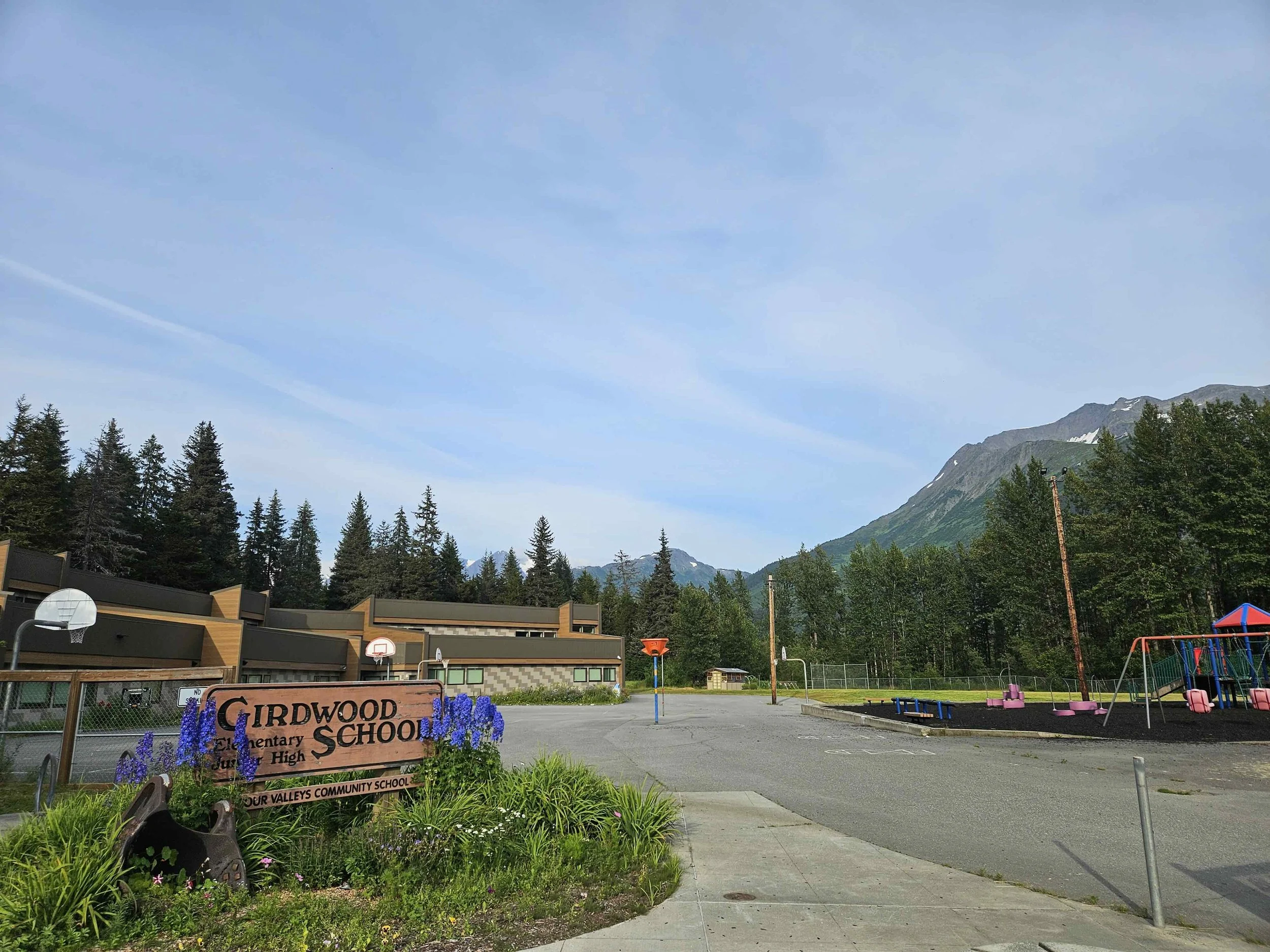
Girdwood’s Four Valleys Community School with Mount Alyeska in the background, as seen on Aug. 9. (Photo by Chase Berenson)
By Chase Berenson
TNews Staffwriter
One of Girdwood’s beloved winter traditions is the Mount Alyeska Snow Classic, hosted by Four Valleys Community School (FVCS). Almost everyone in Girdwood knows that the premise of a snow classic is to purchase a ticket, guess how much snow will have fallen by a certain date, and then win half the pot of money if the guess is right. But outside of Girdwood, snow classics are unknown to many Alaskans. When Alaska legalized snow classic betting in 2012, they only legalized one snow classic in the entire state. Alaska Statute (AS) 05.15.690(47) reads: “‘snow classic’ means a game of chance in which a prize of money is awarded to the closest guess of the total snow accumulation on the ground at a specific location on Mount Alyeska on a specific date and time and is limited to the Alyeska Snow Classic operated and administered by Four Valleys Community School, Inc.”
The law authorizing the Girdwood snow classic was signed by Governor Sean Parnell on June 12th, 2012, after significant effort from FVCS. Rebecca Reichlin and Lynne Doran were FVCS Board members on a subcommittee pursuing a snow classic, and they spent two years working with Senator Cathy Geissel (R) and Representative Mike Hawker (R) to get the bill through the legislature. At the time, Reichlin said, “The community school would like to be more self-sufficient, and we would like to not have to request GBOS grants.” Once the bill was signed into law, FVCS still had more work to do: FVCS had to buy and install a measuring device. In partnership with Alyeska Resort, FVCS bought a measuring stake and FVCS volunteers permanently installed it on the mountain. The stake is marked in tenths and hundredths of a foot.
The first Alyeska Snow Classic was held in 2013, the winter following the new law, and has been held several years since then. Tickets were $2.50 each (though the price went up to $5 in 2018), and FVCS supporters could purchase them at many local merchants around Girdwood. The designated date for checking snow depth was approximately one month after ticket sales ended. On that day, two people visited the stake to measure and verify the snow depth using a line-of-sight laser measuring device. FVCS secured all the tickets until the snow depth was announced, and only then did FVCS record the tickets and declare a winner.
The winner received half of the gross ticket sales as a prize. Over the years, FVCS’ gross revenue averaged $2,500 for the fundraiser. All this work and fun was performed under Alaska’s strict charitable gaming regulations, which allowed FVCS to host a gambling fundraiser due to its non-profit status.
Starting this winter, FVCS’s snow classic will likely no longer be the only one in the state. On July 3rd, 2026, Governor Dunleavy allowed House Bill (HB) 50 to became law without his signature. HB 50 was sponsored by Juneau’s Representative Sara Hannan (D), and it modifies (AS) 05.15.690(47) to remove any mention of Alyeska and FVCS. HB 50 takes effect on September 21st, 2026, and on that day the state’s gaming law will read, “’snow classic’ means a game of chance in which a prize of money is awarded to the closest guess of the total snow accumulation on the ground at a specific location on a specific date and time.” HB 50 passed the House on April 11th, 2025, with a vote of 35 yeas, two nays, and three excused; Girdwood’s Representative Ky Holland (NA) voted yea. HB 50 then passed the Senate the following year on May 20th, 2026, with a vote of 19 yeas and one nay; Girdwood’s Senator Geissel (R) voted yea.
This change to the law allows snow classics to happen anywhere in Alaska and to be administered by any entity who is authorized to host gaming fundraisers. Representative Hannan introduced the bill on January 22nd, 2025, and over the past couple years she has provided two main reasons for the bill.
Primarily, she introduced the bill at the request of the Juneau Nordic Ski Club, as she said on the House floor, “This bill came to me from an organization in my community that would like to host a snow classic.” She continued, “Right now the statute under law specifies it very narrowly to one classic in one community with one beneficiary. We have several classics in state law that do not require that specificity. Any charitable gaming organization is able to run a ‘rain classic,’ but our Nordic ski club youth program here would like to run a snow classic and so the bill is before you.” Frankie Pillifante, the president of the Juneau Nordic Ski Club, echoed Representative Hannan in a letter to legislators on February 12th, 2025. She wrote that the organization currently raises more than $30,000 annually to support its youth skiers, “but our sources are strained with the ever-increasing cost of equipment, insurance, travel, and the many other costs associated with operating a ski program.” The letter continues, “Fundraising is vital in providing financial support to our athletes, ensuring that all have the opportunity to participate. Many youth sports programs [in areas of] Alaska not connected by road are presented with significant financial challenges and conduct community-based fundraising to support the higher cost of travel, equipment, and coaching. HB 50 legislation is an essential fundraising tool for the continued success and growth of the youth ski programs that include elementary, middle, and high school levels.”
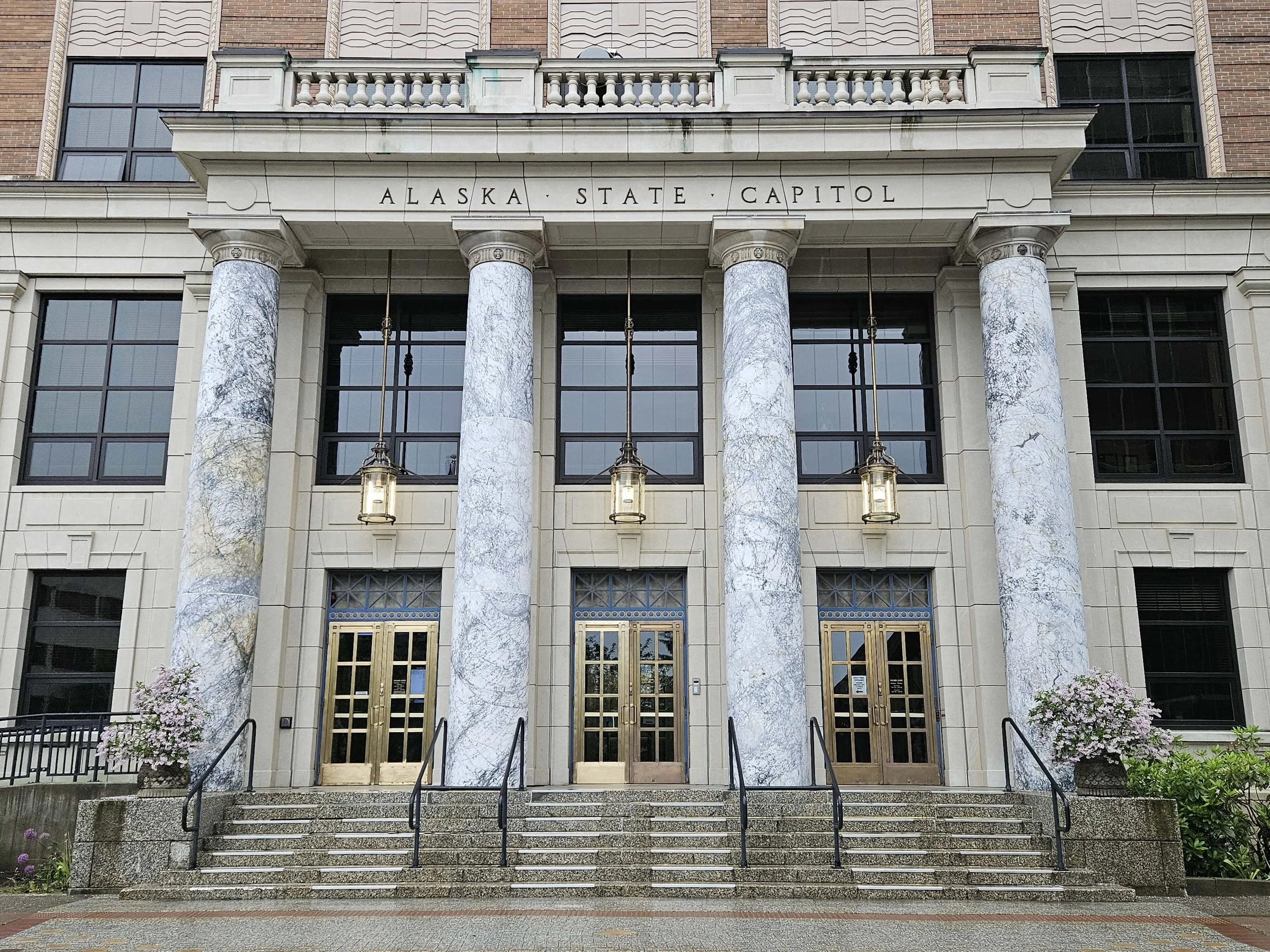
The Alaska State Capitol in Juneau, as seen on July 6. (Photo by Chase Berenson)
Though the Juneau Nordic Ski Club was the primary influence for the bill, it was also supported by Haines Huts and Trails. Nate Arrants, the executive director of Haines Huts and Trails, also wrote a letter of support to legislators from the organization that develops and maintains public use backcountry cabins and trails in the wilderness around Haines. Arrants wrote, “Many rural and off-road-system communities in Alaska, like Haines, face unique financial challenges in maintaining outdoor infrastructure, and this legislation would provide a critical funding mechanism to help bridge the gap.”
The second reason for Representative Hannan to introduce the bill seemed to be from a perspective of general fairness. She said, “the provision around a snow classic was restricted to Mount Alyeska and Girdwood community school as its beneficiary. So House Bill 50 was introduced. Just take that very narrow specificity out of the law." She continued to say that, “our laws are supposed to exist statewide,” and generally Alaska laws are prohibited from legislation that benefits only a single person or entity.
While HB 50 is being applauded in other areas of the state, it was a surprise in Girdwood. Julie Johnson, the executive director of FVCS, told the Turnagain News that FVCS was not contacted regarding HB 50 as it moved through the legislative process. Now that HB 50 has passed, FVCS is not expecting it to directly cause any changes to their operations. The people who purchased tickets for the Alyeska Snow Classic were mainly Girdwood residents, with a smaller percentage from Anchorage and Kenai but even they were people who had ties to the community. Ticket purchasers were generally not people from other parts of the state who might abandon the Alyeska Snow Classic if a new snow classic starts in their region. And thinking back to FVCS’ 2012 legislative efforts, Johnson said, “I don't think the expectation was that the Alyeska Snow Classic would be the only one allowed to be designated and run as a snow classic.” But, she added, “FVCS was happy for the ‘protection’ from similar competing events.”
As Alaska prepares for HB 50 to become the law of the land, it’s important to note that some things won’t change as snow classics take place around the state. Representative Hannan pointed out that, “House Bill 50 does not change any of the basic logistics or qualifications to be a charitable gaming organization or to operate a classic.” And the Department of Revenue published a fiscal note projecting that there will be no costs to the state due to the changes introduced by HB 50.