USS Ted Stevens Enters US Navy Fleet in Whittier Commissioning Ceremony
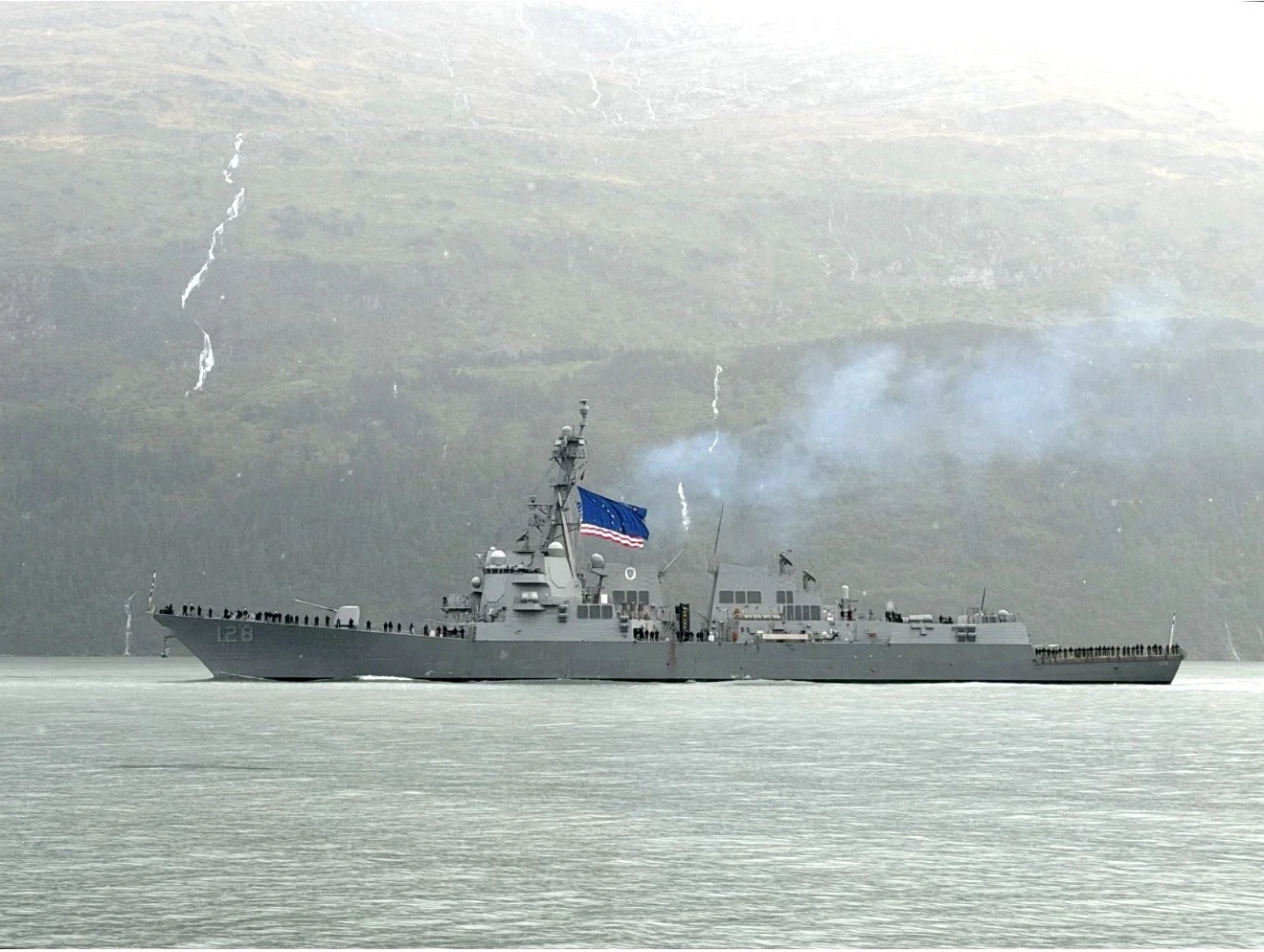
The USS Ted Stevens transits Passage Canal to arrive in Whittier on Sept. 27 before the Commissioning ceremony. (Photo by Lucas Gamble)
By Chase Berenson
TNews Staffwriter
People streamed into Whittier Saturday morning on buses and trains for the commissioning of the USS Ted Stevens, the newest United States Navy vessel.
The event was the culmination of years of preparation and a week’s worth of events when the Commissioning was held in Whittier at the Whittier Cruise Terminal. It was a chilly day for an outdoor ceremony, with rainy weather and a temperature of 38 degrees at the start of the event. But that didn’t seem to dampen the spirits of the guests, audience, and sailors in attendance.
Getting to Whittier typically has some hurdles, but there were extra obstacles on Saturday. The Anton Anderson Memorial Tunnel, which is the only road connection to Whittier, was closed to public traffic. Whittier was only accessible by bus or train organized by the Commissioning Committee, and those were only available to people who had received tickets to the Commissioning.
Once in Whittier the crowds arrived at the Whittier Cruise Terminal for security checks, which some people found surprisingly lax. Multiple people said no one ever checked their ID nor were confirmed they had tickets, and anyone could have gained access to the pier alongside the ship to watch the ceremony.
Just beyond the security checkpoint, the Service High School Junior Reserve Officers’ Training Corp was handing out event programs, ponchos, and water bottles. After emerging from the building onto the pier, participants saw that the ship was decorated with red, white, and blue bunting for the occasion. The distant mountains were obscured by clouds behind the ship, but when it was possible to glimpse them through the shifting weather they were covered with fresh snow.
The pier ran alongside the ship, with seating areas set up parallel to the ship facing towards the Commissioning’s main stage at approximately the ship’s midpoint. Due to the way the crowd was seated many people couldn’t see the ceremony directly, but there were large screens along the pier to show the action on the stage.
The event began when Commander Stephen Roman, the Executive Officer of the ship, called it to order. After 19 cannons were fired, many dignitaries and speakers took the stage over the next 90 minutes.
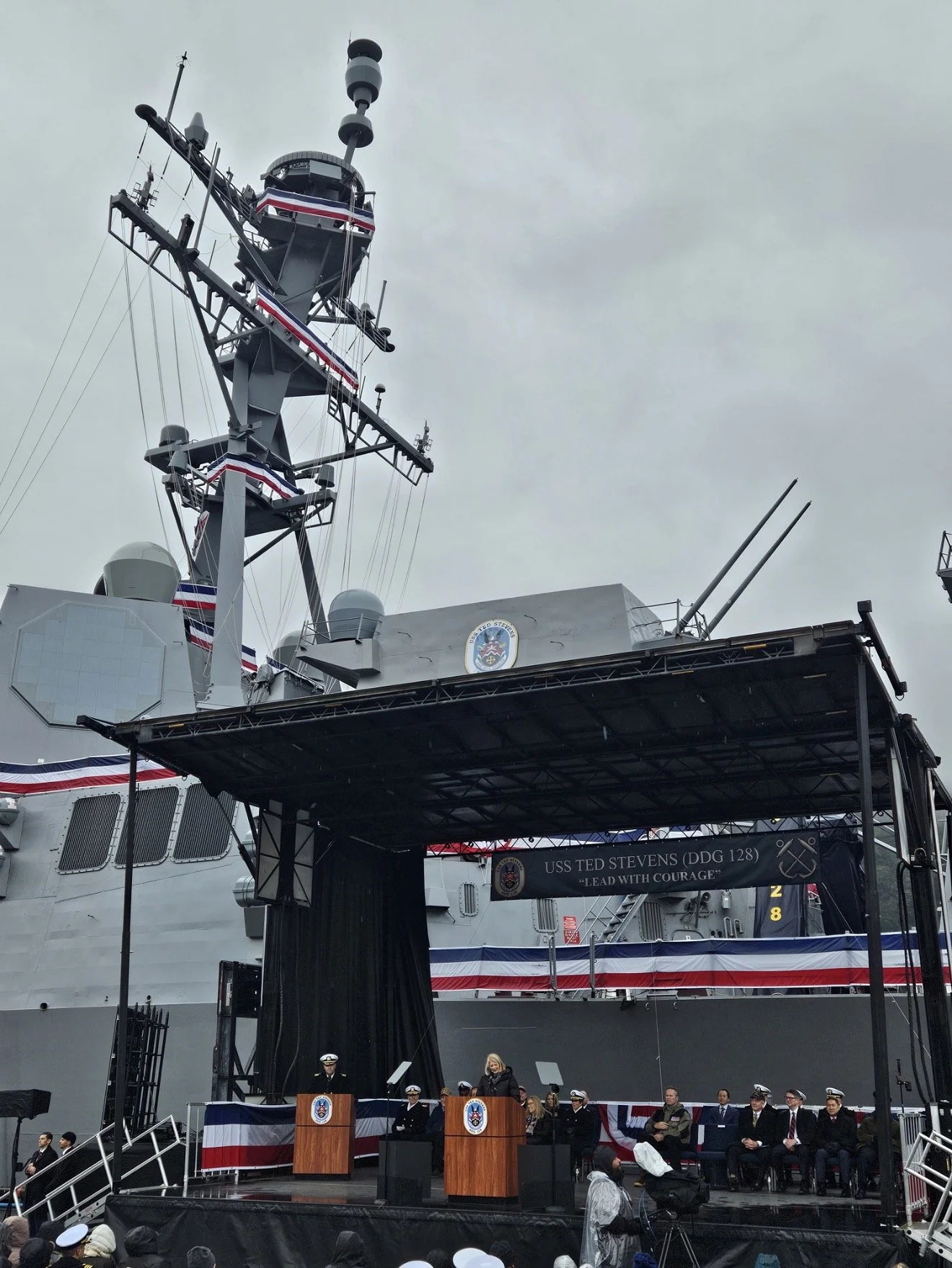
Senator Lisa Murkowski speaks at the Commissioning of the USS Ted Stevens on Oct 3. (Photo by Chase Berenson)
Gov. Mike Dunleavy was the first speaker, and, though he mistakenly referred to the commissioning as a “christening” multiple times, he also said that, “Alaska is central to America’s security, from the Arctic to the Pacific” and that this ship represents commitment to America’s strength and leadership.
An out-of-state speaker was Brian Blanchette, the President of Ingalls Shipbuilding in Pascagoula, Mississippi, who built the USS Ted Stevens and hosted its christening on Aug 19, 2023. He discussed the pride of the 11,000 shipbuilders who started with raw steel and wires to create the ship and he said it was their privilege to do it. He was excited to be at the Commissioning because, “today DDG 128 becomes the USS Ted Stevens.”
The weather was a common theme for many speakers, including both of Alaska’s US Senators. Senator Sullivan was the first Senator to speak and hyped up the crowd by saying, “What a beautiful day in Whittier! We love Whittier! It’s a little rainy, but that’s alright.”
Senator Murkowski spoke next and took a slightly different approach, looking out at the crowd and seeing many people wearing the plastic ponchos provided by the JROTC. She said, “Today is a beautiful day. I see you sitting out there in your little strips of Visqueen, and you probably think ‘liar!’ But today reminds us to be Alaska tough. The weather does not slow or stop us.”
Murkowski finished her speech by speaking to Captain Hays and the crew, saying, “You may not have chosen this name, but you inherit his legacy. Carry his spirit, Hulk out if you need to, and lead with courage.”
The final speaker was Acting Secretary of the Navy and nominee for Secretary of the Navy Hung Cao. He said it was his first time to Alaska but likely not his last because, “Alaska is the most strategic place in the world.” He also took pride in the act of commissioning, because “today this ship joins the fleet” and “when she heeds a radio call, she no longer responds with the title US Government Ship, because now she can respond by saying US Warship.”
After the speakers, Commander Roman turned to the ceremonial events of the day. Captain Hays formally asked Acting Secretary Cao to put the ship in commission, which he did. Commander Roman issued the order for the US colors and the ship’s pennant to be hoisted from the mast. Once that task was complete, Captain Hays took a moment to look out at the crowd and at her sailors before her voice boomed through the microphone: “Secretary, this ship is in commission, and I am reporting for duty.”
The highlight of the ceremony came next, when the ship's sponsors spoke briefly and then gave the command, “Man our ship and bring her to life!” At that command, the hundreds of crewmembers ran through the aisle of the crowd and up the gangplank onto the vessel. This was an emotional moment for the ship’s first crew, and many of them were tearing up while they ran through the crowd.
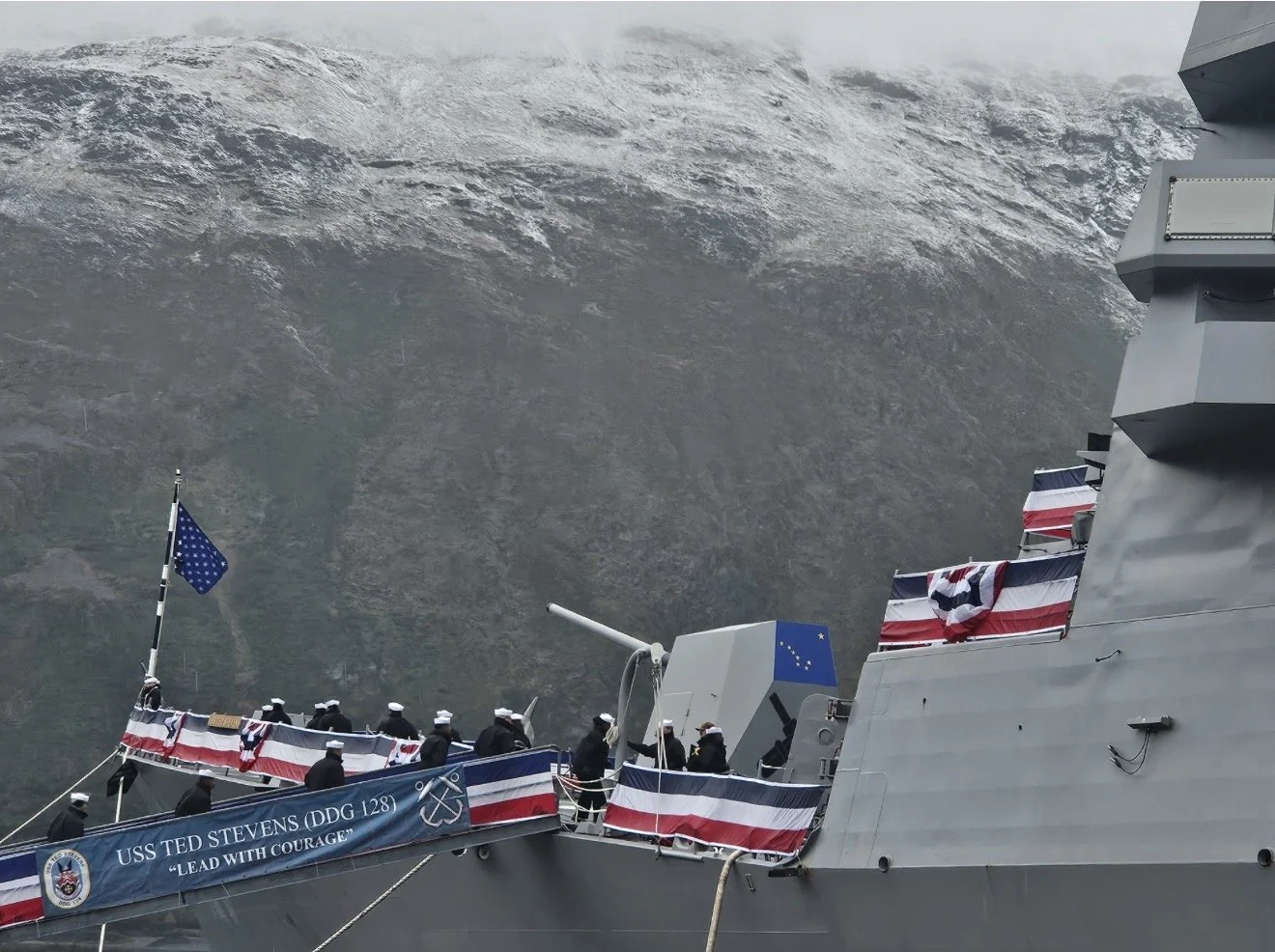
After receiving the command to “Man our ship and bring her to life!”, the crew lines the ship’s rails. As the ship is coming to life, notice that the fo’c’sle gun has swiveled to an angle where the Alaska state flag can’t be seen. (Photo by Chase Berenson)
As they boarded the ship, almost all of them started lining up at the ship’s rail over the crowd starting from the bow and working their way to the stern. The rail was lined with sailors standing at attention. The crew lined the rails at various levels, some higher and lower. When the ship’s rail was full, the final crew took their position standing at attention on the gangplank facing the crew.
Some members of the crew took their positions inside the ship to start controlling various elements of the ship’s equipment and “bringing them to life.” In a choreographed maneuver, as the line of sailors along the rail reached an element of the vessel such as a gun turret or a radar dish, those elements “came to life” and started spinning. The ship’s sirens sounded.
It took several minutes for the crew to board and the ship to come to life. In this cacophony of sound and movement, the final element was the ship’s thunderous horn. As soon as the horn stopped, Captain Hays’ voice again boomed through the microphone: “Secretary, the USS Ted Stevens is reporting for duty.”
After a couple more minutes of formalities and a speaker describing logistics for the audience to reach the reception, the Commissioning ended with Commanded Roman notifying the sailors, “Ted Stevens, dismissed!” The crew finally broke from standing at attention, with many of them smiling and shaking hands or giving high fives with their friends and coworkers standing next to them. They were now officially the first crewmembers of the USS Ted Stevens.
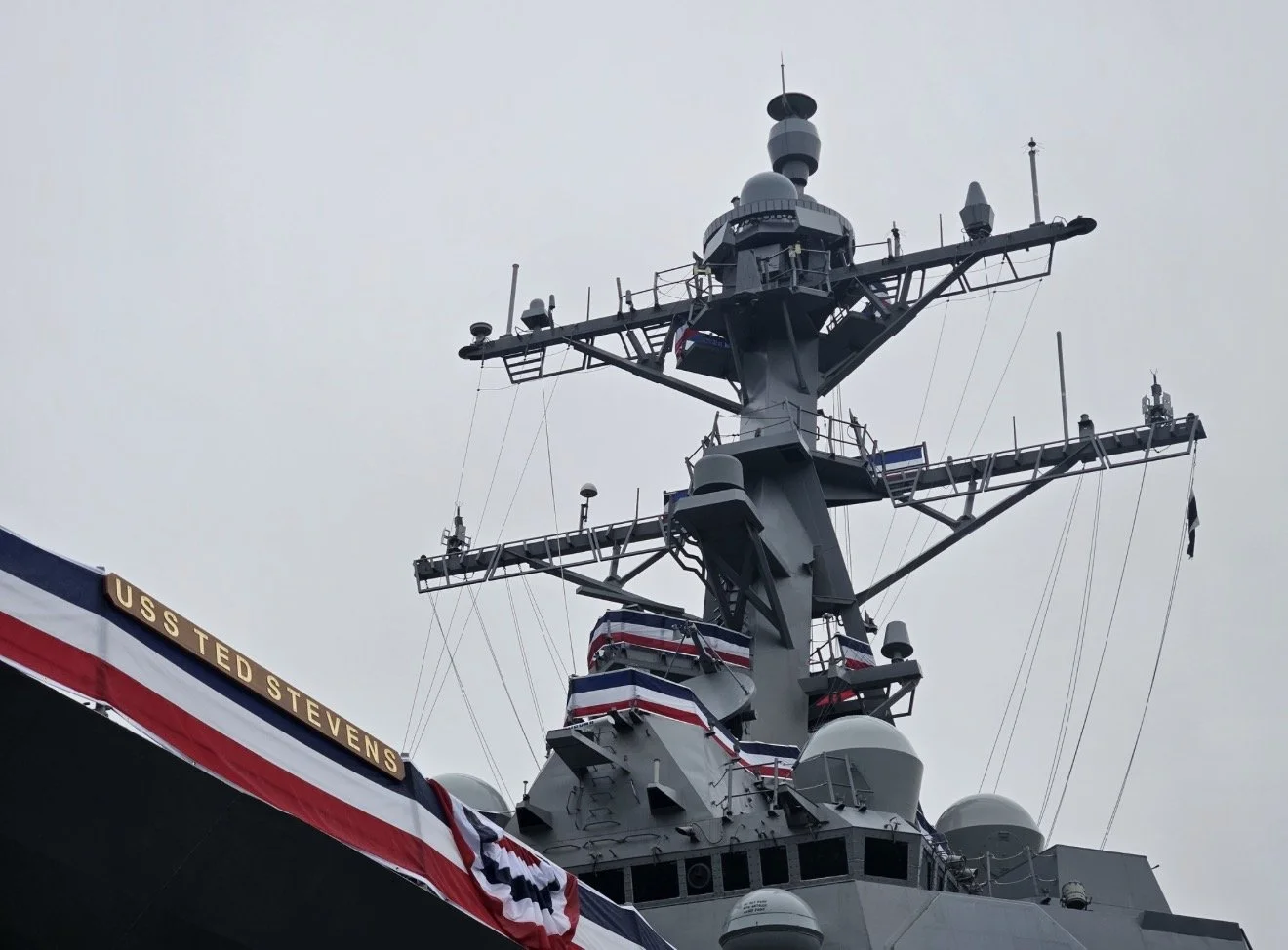
The structure of the USS Ted Stevens as seen with an overcast sky on Oct 3 in Whittier before the start of the Commissioning. (Photo by Chase Berenson)
About the Commissioning
A Commissioning ceremony is when a vessel formally enters the US Navy fleet and when the ship gets her name. Commissioning ceremonies are historical traditions, practiced by the US Navy for over 100 years.
This ship was delivered to the US Navy by Ingalls Shipbuilding on Dec 29, 2025, and since then it has been called either by its hull number DDG 128 or referred to as “the future USS Ted Stevens.” Captain Hays also had a preliminary title; instead of Captain, she was the Prospective Commanding Officer of Pre-Commissioning Unit Ted Stevens. That all changed on Saturday.
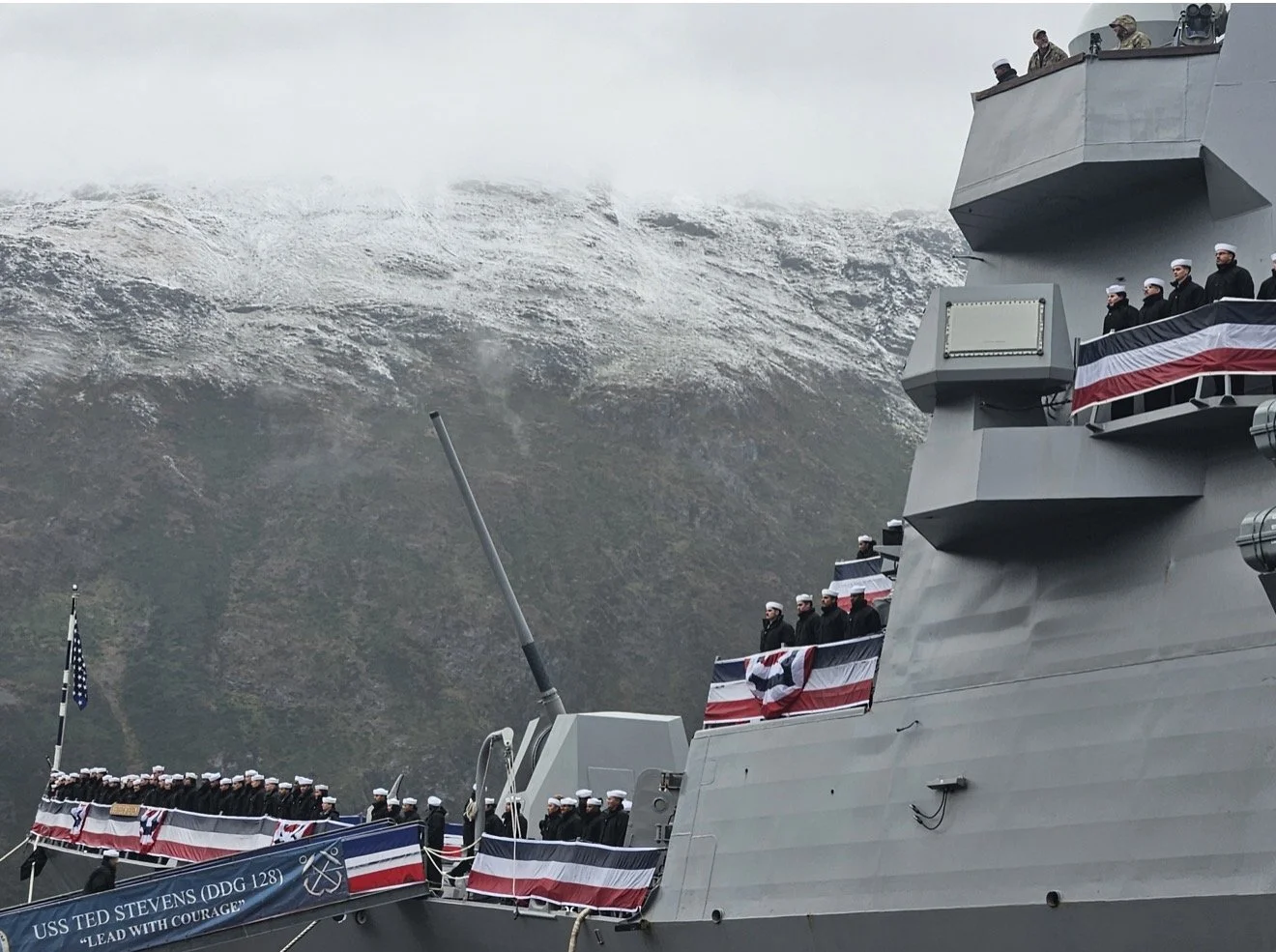
After receiving the command to “Man our ship and bring her to life!”, the crew runs up the gangplank. The ship’s fo’c’sle has an Alaska state flag painted on it. (Photo by Chase Berenson)
The USS Ted Stevens
The USS Ted Stevens is the third ship of the Navy’s Arleigh Burke-class destroyer Flight III series. Arleigh Burke-class destroyers are a class of guided-missile destroyers that feature the Aegis Combat System and the SPY-6(V)1 multi-function passive electronically scanned array radar. Prior to the event, Cao described the vessel by saying, “Equipped with cutting-edge systems and capabilities, USS Ted Stevens is ready to answer our nation’s call to counter aggression and safeguard our interests by providing a powerful advantage at sea.”
The Arleigh Burke-class ships are multi-mission destroyers, and the Navy uses these warships in a variety of contexts. They are designed specifically to maintain seaworthiness while operating at high speeds even in rough seas. They can be used for anti-aircraft warfare with surface-to-air missiles, antisubmarine warfare with antisubmarine rockets, land strikes with Tomahawk missiles, and antisurface warfare with ship-to-ship missiles.
There have been no announcements about how much the Navy paid for the USS Ted Stevens. In general, the Pentagon estimates that each Flight III ship costs approximately $2 billion, which includes approximately $1 billion for the ship itself and approximately $1 billion for the ship’s equipment.
On Wednesday the Turnagain News interviewed Captain Mary Hays, the commanding officer of the USS Ted Stevens, about her experience in our local area. She said, “The crew is glad to be in Whittier.” Everyone is so friendly there, and the people of Whittier are treating the crew very well. She said her personal highlights were learning about Whittier’s military history at the Prince William Sound Museum and viewing marine mammals such as otters from the bridge of the ship.
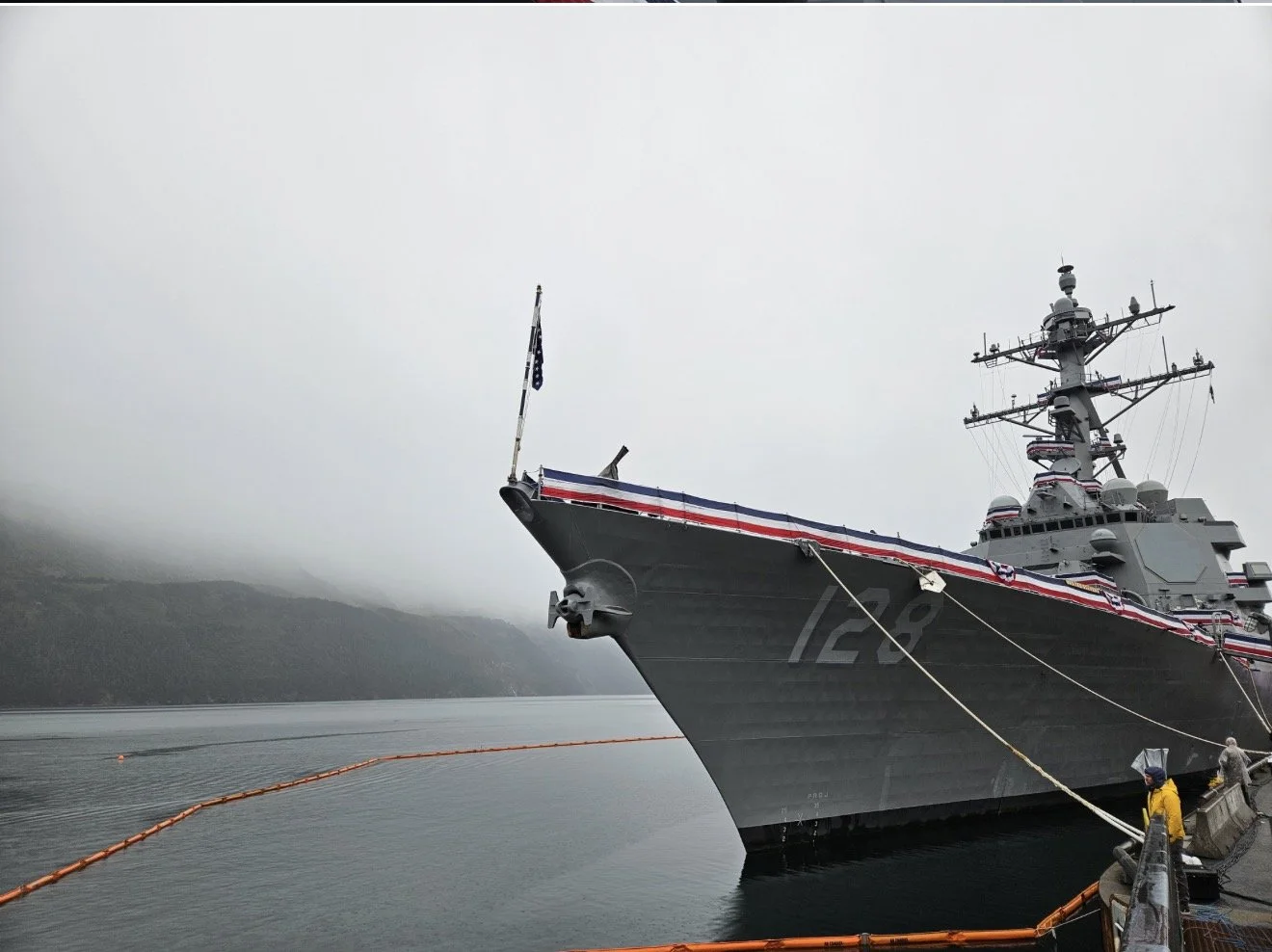
The USS Ted Stevens at the Whittier Cruise Ship Terminal on Oct 3 before the Commissioning. (Photo by Chase Berenson)
Ted Stevens
Born in Indianapolis, Indiana, on Nov 18, 1923, Ted Stevens served in the Army Air Corps during World War II. The Army Air Corps is the predecessor to today’s Air Force, and Stevens was a military pilot. He flew missions with the 14th Air Force in support of the Flying Tigers in the China Burma India Theater, flying over “The Hump.”
Stevens was appointed to the US Senate in December 1968 upon the death of Senator Bob Bartlett. Once Stevens was in the Senate, he was reelected several times and remained in place for over 40 years until January 2009. He served as the President Pro Tempore in the Senate from 2003-2007, and he set the record at the time for the longest-serving Republican Senator.
In Washington, DC, he was known as a fierce supporter of Alaska, while throughout his home state he became known as Uncle Ted. He passed several major bills that impacted Alaska throughout his career in the Senate, including Alaska Native Claims Settlement Act in 1971, the Trans-Alaska Pipeline Authorization Act in 1973, and the Magnuson-Stevens Fishery Conservation and Management Act of 2006. Stevens died on Aug 9, 2010, in a plane crash in the Muklung Hills near Aleknagik.