Whittier natural gas shutdown shows vulnerability of communities outside the Anchorage bowl
By Chase Berenson
TNews Staffwriter
Whittier residents may have to wait until Sept. 5 or later before the flow of gas resumes through a pipeline connecting the port town’s gas supply to Anchorage.
Enstar shut off the natural gas to the entire community of Whittier earlier last month due to a pipeline leak discovered by a boater on the Twentymile River.
Enstar succeeded in finding an alternate source of natural gas significantly ahead of schedule and turned Whittier customers back on after only one week, Aug. 23.
While this accelerated restorage is great news for the residents of Whittier, it also prompts concerns about what caused the outage and whether other communities could be at risk for the same situation.
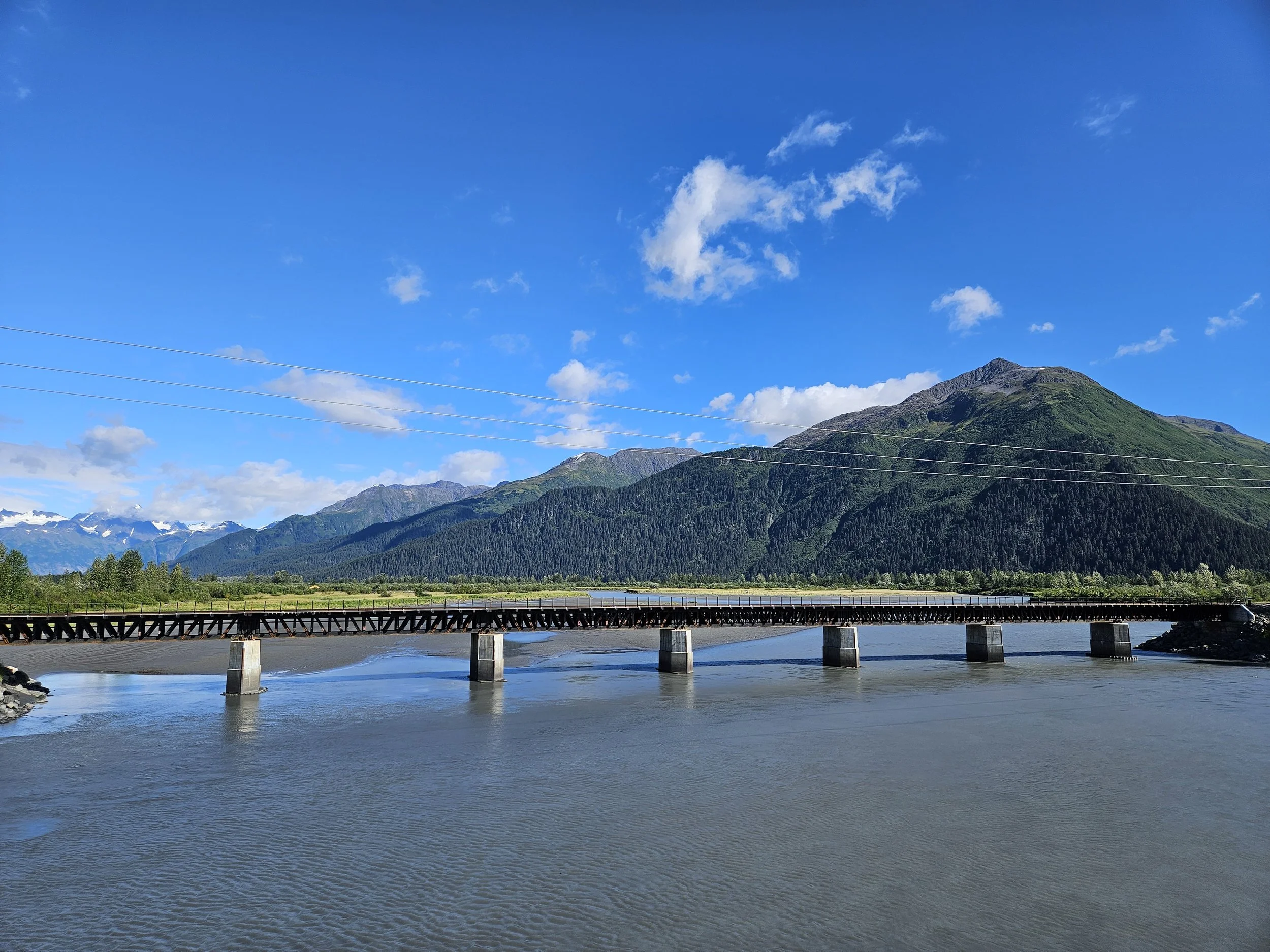
The view north of Twentymile River from the Portage Curve Multimodal Connector pathway on the Seward Highway bridge over the Twentymile River as seen on Saturday, August 29th. Barely visible in this photo beyond the Alaska Railroad bridge and the Chugach Electric power lines, a crew was working with an excavator and various equipment; it is assumed that this is Enstar’s crew working on the pipeline repair. (Photo by Chase Berenson)
Enstar Natural Gas Company is the largest gas utility in Southcentral Alaska and serves over 57% of Alaska’s population. It was founded as Anchorage Gas in 1959 and started providing gas service to Anchorage in 1961. The utility’s service area expanded to Girdwood in 1996, and Enstar serves approximately 1,615 customers in Glacier City.
This situation in Whittier was prompted Aug. 9, when the boater smelled natural gas and reported it to Enstar. Enstar crews investigated and discovered a pipeline break in an underground pipeline near the river. While the utility evaluated potential repairs, they also made plans to truck in liquified natural gas from Fairbanks as a substitute fuel for the community.
The pipeline condition continued getting worse, with the pipeline eventually rupturing and causing pressure drops in Whittier, Enstar spokesman John Sims said at an Aug. 19 Whittier City Council meeting.
The rupture was approximately one-half mile upstream of the mouth of the river where it meets Turnagain Arm. The rupture required the flow of gas to be shut off to the downstream customers of Whittier, which happened before Enstar had acquired the substitute fuel. The plan to truck LNG from Fairbanks fell through because Enstar lacked a needed component to regasify the LNG into their system according to Heather Hedlund, Enstar’s Communications Manager.
Vulnerability of Enstar’s outer communities
This pipeline rupture exposed vulnerabilities in Enstar’s natural gas supply system outside the Anchorage Bowl.
Enstar’s natural gas distribution network is a system of transmission and distribution pipelines known as “one-way feeds,” one of which serves natural gas to southern communities outside the Anchorage Bowl.
Hedlund told the Turnagain News that the pipeline originates in Anchorage, runs over Powerline Pass in Chugach State Park, drops down to Indian Creek, runs along the Seward Highway/Alaska Railroad corridor to Girdwood, and then continues to Whittier.
The pipeline is eight inches in diameter and is fully underground except for valve and pressure regulating stations. Sims said the pipeline is military infrastructure installed decades ago and originally used as a fuel line for Anchorage’s Elmendorf Air Force Base (which has been part of Joint Based Elmendorf-Richardson since 2010).
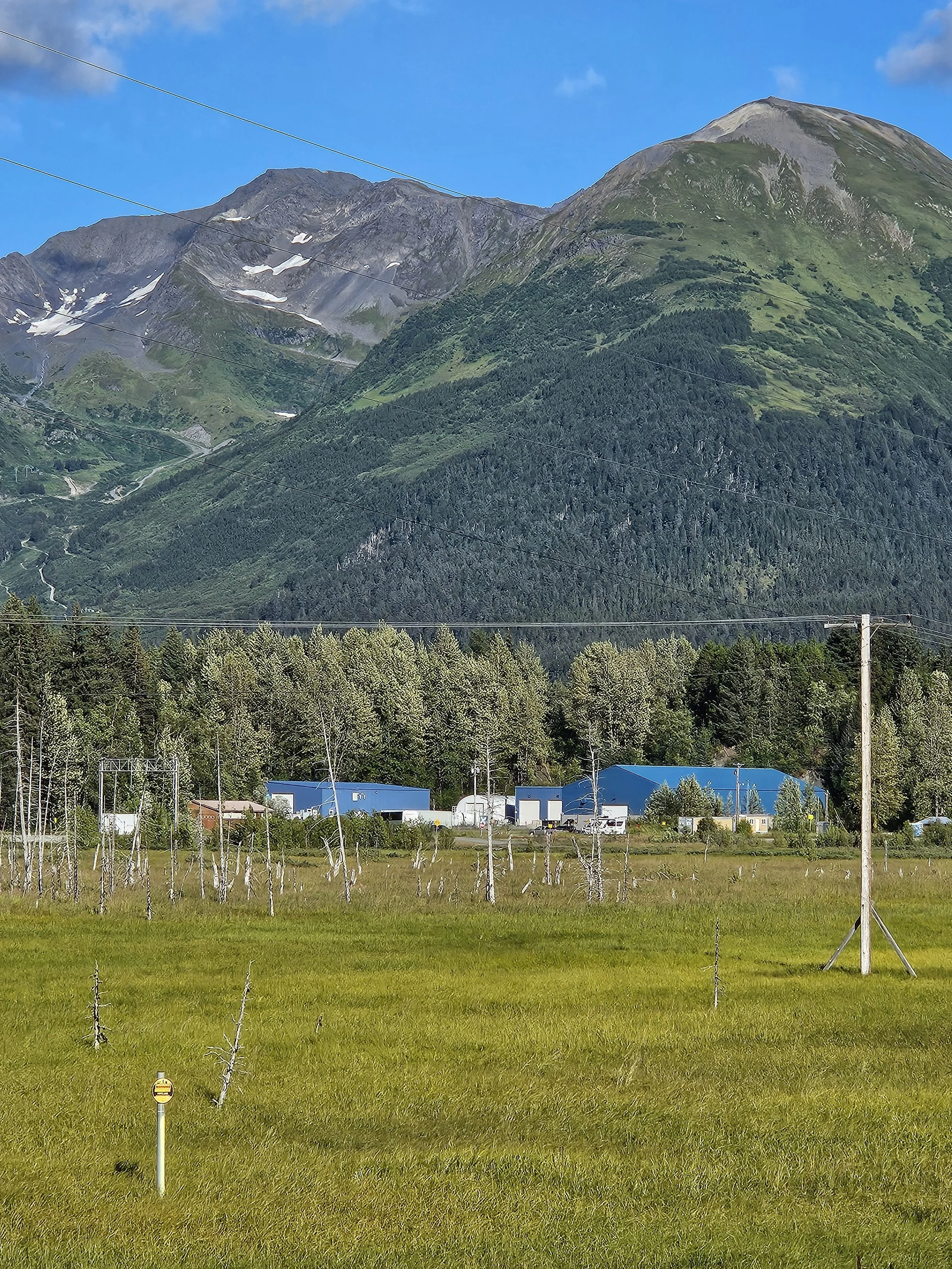
Enstar rejected Turnagain News’ request for a pipeline map by saying, “Detailed mapping of Enstar’s facilities is considered critical energy infrastructure information, and federal requirements restrict Enstar from releasing that information.” However, the round yellow sign in the foreground says, “Pipeline Warning” and this type of pipeline marker typically indicate an underground natural gas pipeline. It is assumed that this marker indicates the pipeline’s path through the marsh along mile 90 of the Seward Highway as it enters Glacier Valley from the north, as seen on Sat, Aug. 29. (Photo by Chase Berenson)
As of Friday, Enstar was still investigating the rupture and the exact cause has not yet been determined according to Hedlund.
“When Enstar initially responded on August 9, the affected section of pipeline was exposed in the Twentymile River and was observed moving with the river current," Hedlund said.
It is too early to suggest whether the rupture was caused by the river itself, but the Twentymile River isn’t the pipeline’s only underwater crossing. It also crosses under Bird Creek and some smaller drainages along the route from Anchorage to Girdwood.
Hedlund said Enstar performs routine monitoring and inspections along the pipeline distribution network, and when concerns are identified the utility works to resolve them.
“It would be premature to determine whether this incident will result in changes to those programs before the affected section of pipeline has been evaluated,” she said.
Girdwood Reinforcement Pipeline
Connecting these communities with only one pipeline creates an inherent risk.
If there were to be a rupture or other pipeline disturbance between Anchorage and Girdwood, Girdwood (and the downstream community of Whittier) could experience a natural gas shutdown like Whittier experienced last month.
Hedlund says that this lack of redundancy is just one of the reasons Enstar has been working for years to install the Girdwood Reinforcement Pipeline. The Girdwood Reinforcement Pipeline would create a two-way feed on the local distribution system for the community instead of Girdwood’s current one-way feed, and this would increase reliability and potentially allow service to continue in the event of a rupture in the community.
The Girdwood Reinforcement Pipeline was presented to the Girdwood Board of Supervisors in July, 2023.
Enstar’s proposed four-inch diameter pipeline would extend from Ruane Road to Virgin Creek Road with a section drilled under Glacier Creek, a route that would result in a 20-foot clearcut through some of Girdwood’s old growth forest with potential impacts to the Lower Iditarod Trail and Joe Danich Trail.
Sterling Lopez, a permitting agent for Enstar who spoke at the meeting, said the project is for “viability.” Referring to the single distribution main, Lopez added that damage to the existing line could “bring down service to every single user of natural gas down the system.”
Throughout the GBOS meeting there were no public comments in favor of the plan, though several Girdwood residents voiced concerns about the pipeline. Shelly Rowton said, “You're going to go through old-growth forest that cannot be replaced. ... You're going to destroy the character of the Joe Danich trail. You're going to destroy the character of the Iditarod National Historic Trail.” Longtime resident and former GBOS supervisor said, “It's going to tear the hell out of everything. You have a significant number of trees that are hundreds of years old, primary growth trees.”
Residents also raised objections about the short notice Enstar provided for the project and the short, 14-day public comment period. "You don't just show up and say, 'hey this what we're doing in two weeks.' It's just wrong,” said resident Mary Jo Thill. Mitch Roth told supervisors, “This train is leaving the station and I'm trying to run down the platform to see where we're going.”
GBOS supervisors asked the Alaska Department of Natural Resources to deny the project. The DNR later approved the project, however, citing a 52-year-old section line easement along the planned route.
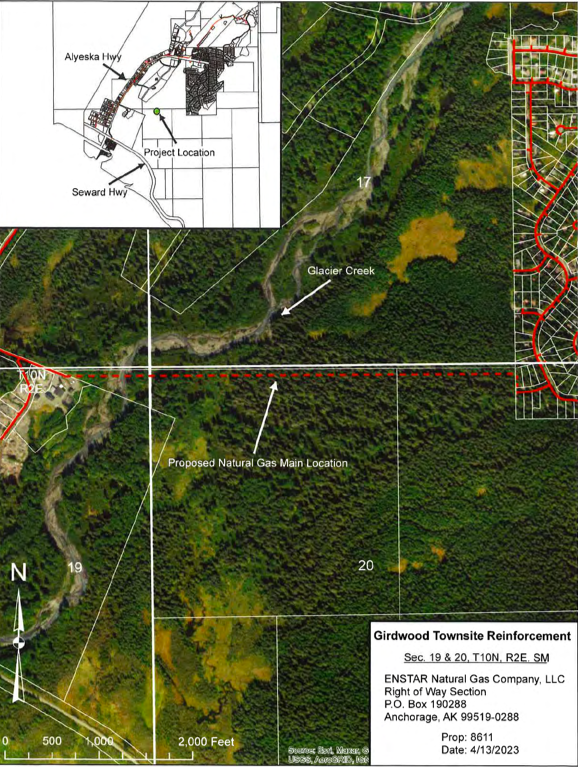
This map features the proposed path of the Girdwood Reinforcement Pipeline from Ruane Road to Virgin Creek Road. (Map courtesy of meeting materials from the July 17th, 2023, GBOS meeting
Girdwood is not the only location in Enstar’s service area in this situation. In 2022, Enstar installed over 40,000 feet (over 7.5 miles) of distribution main elsewhere in its system to ensure that areas served by a single one-way pipeline (like Girdwood) can have the redundancy of a secondary feed.
A secondary feed also ensures that hydraulic pressure at the end of the line stays high enough to maintain service in the winter according to Steve Cooper, Enstar’s vice president of operations and engineering.
Girdwood’s close call
“On a local level, Girdwood’s distribution system is supplied from a single distribution main” from the Girdwood Regulator Station located near Ruane Road, said Hedlund.
The majority of Girdwood’s customers are served from the main, a plastic pipe with a 6-inch diameter.
This pipe travels from the Ruane Road regulating station north-northeast along Alyeska Highway.
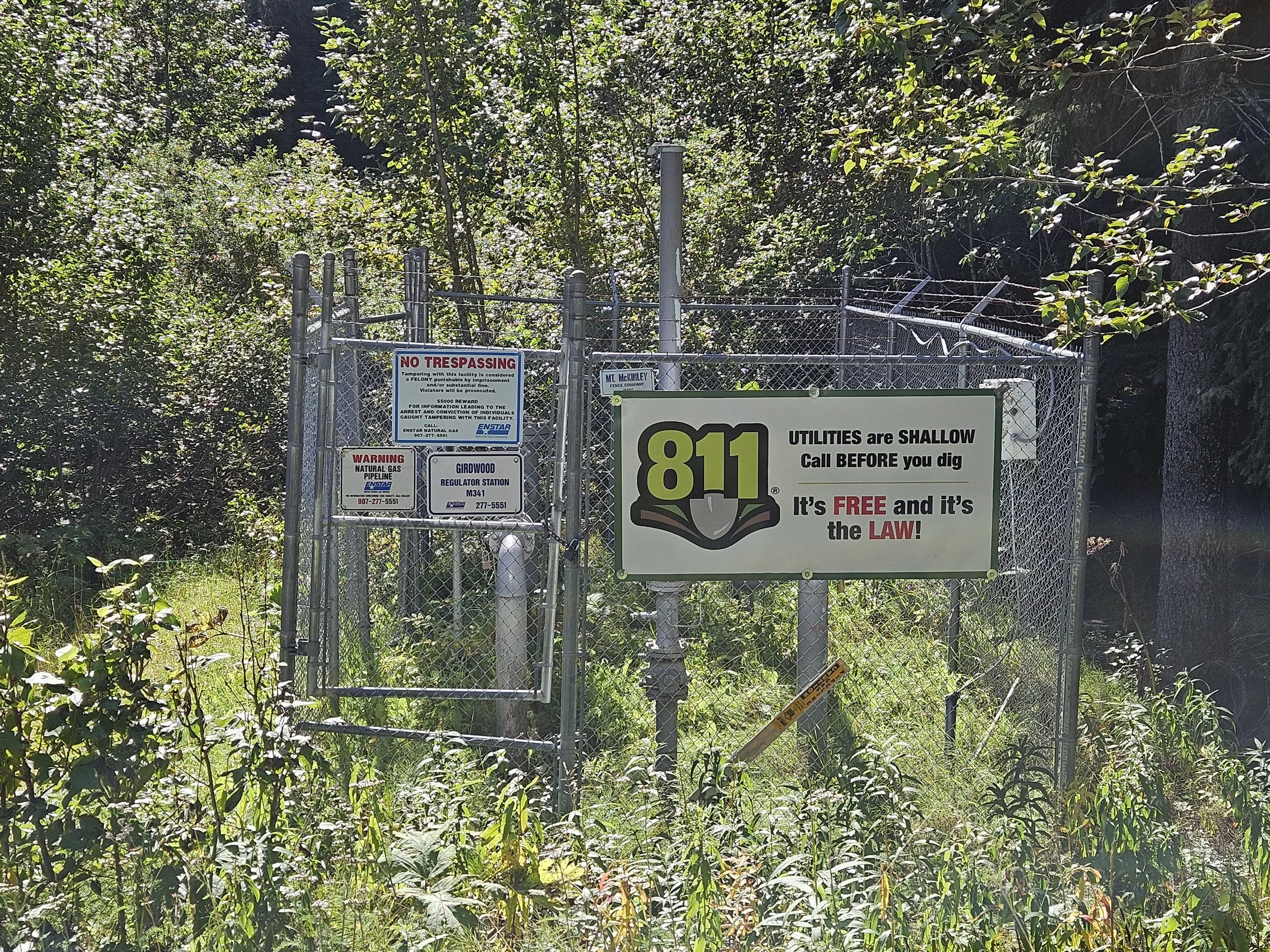
Enstar’s Girdwood Regulator Station as seen from Ruane Road on Saturday, August 29th. This is the location from which Enstar’s distribution main serves Girdwood customers. (Photo by Chase Berenson)
Cooper wrote a 2023 letter to GBOS and the DNR stating gas disruption could result from damage to the line.
He wrote that the biggest threat to Enstar’s pipelines is third-party excavators who hit pipes while digging. Throughout the Enstar service area, this happens more than 100 times per year, according to Cooper.
In August, 2016, Granite Construction was working as a subcontractor for the Alaska Department of Transportation & Public Facilities on an Alyeska Highway project. During its work, Granite struck the six-inch plastic gas line into Girdwood.
“Thanks to the fortuitous timing and the multiple steps undertaken by Enstar, service was maintained to all Girdwood customers,” Cooper said. Enstar crews were able to quickly build a temporary bypass to allow gas flow to continue past the damaged line while they performed repairs.
Cooper credits three factors to maintaining service in Girdwood:
“Timing”: Natural gas usage is often seasonally dependent with higher gas usage for heat in the winter. Since the 2016 line break happened in the summer, when gas usage is at its lowest point of the year, there was not much demand on the pipeline.
“Voluntary load reductions”: Enstar asked Alyeska Resort to switch to its back-up fuel and remove its load from the natural gas line. Alyeska complied with the request.
“Luck”: Cooper writes, “Had the first two [factors] not coincided, Girdwood would have experienced a mass loss of service.” The Girdwood distribution main typically operates above 50 pounds per square inch. During this gas disruption pressure dropped to 5 PSI.
Had those factors not occurred, approximately 1,000 Girdwood homes and businesses would have lost natural gas service that day according to Cooper.
Restoring natural gas after an outage is not as simple as restoring other utilities.
After a natural gas outage a worker must physically visit and inspect every customer connection.
Cooper estimated that if an outage of this size had occurred, it would have taken up to seven days to restore service to customers once the pipeline had been repaired.
In addition to “luck” cited as a factor by Enstar, Cooper’s letter said there have been changes to Girdwood’s customer base.
The number of customers served by Girdwood’s distribution main grew by 7% between 2016 and 2023, and has likely grown even more in the last three years. Additionally, the Alyeska Nordic Spa has been built, which places a significant load on the pipeline.
Turning Whittier’s natural gas back on
After Whittier’s gas was already shut off, Enstar secured a supply of LNG that could be used as a temporary fuel. The problem was that it was over 2,000 miles away in Edmonton, Alberta, on the other side of the Canadian border.
The Canadian LNG was transported from Edmonton to Portage along with specialized equipment to regasify properties.
This temporary solution was functional by Aug. 21. However, because Enstar employees needed to visit and inspect each customer, some Whittier customers had service resumed the following day (except for one customer who requested to be turned on the day after that).
While this temporary LNG supply brings gas back to Whittier’s customers, the fix doesn’t actually solve the problem of the ruptured pipeline. Enstar is still working on permanent repairs to the pipeline, and doesn’t expect those repairs to be completed until mid-September, which is over a month after the issue was first reported.
According to signage seen at the Twentymile River boat ramp on the Seward Highway on Saturday, Enstar is planning on divers and boats performing “underwater salvage” activities in the river Sept. 2 - 4.
During these activities the river will be closed to boat traffic. Friday immediately precedes the three-day weekend for Labor Day when there may be more boaters than normal attempting to use the river.
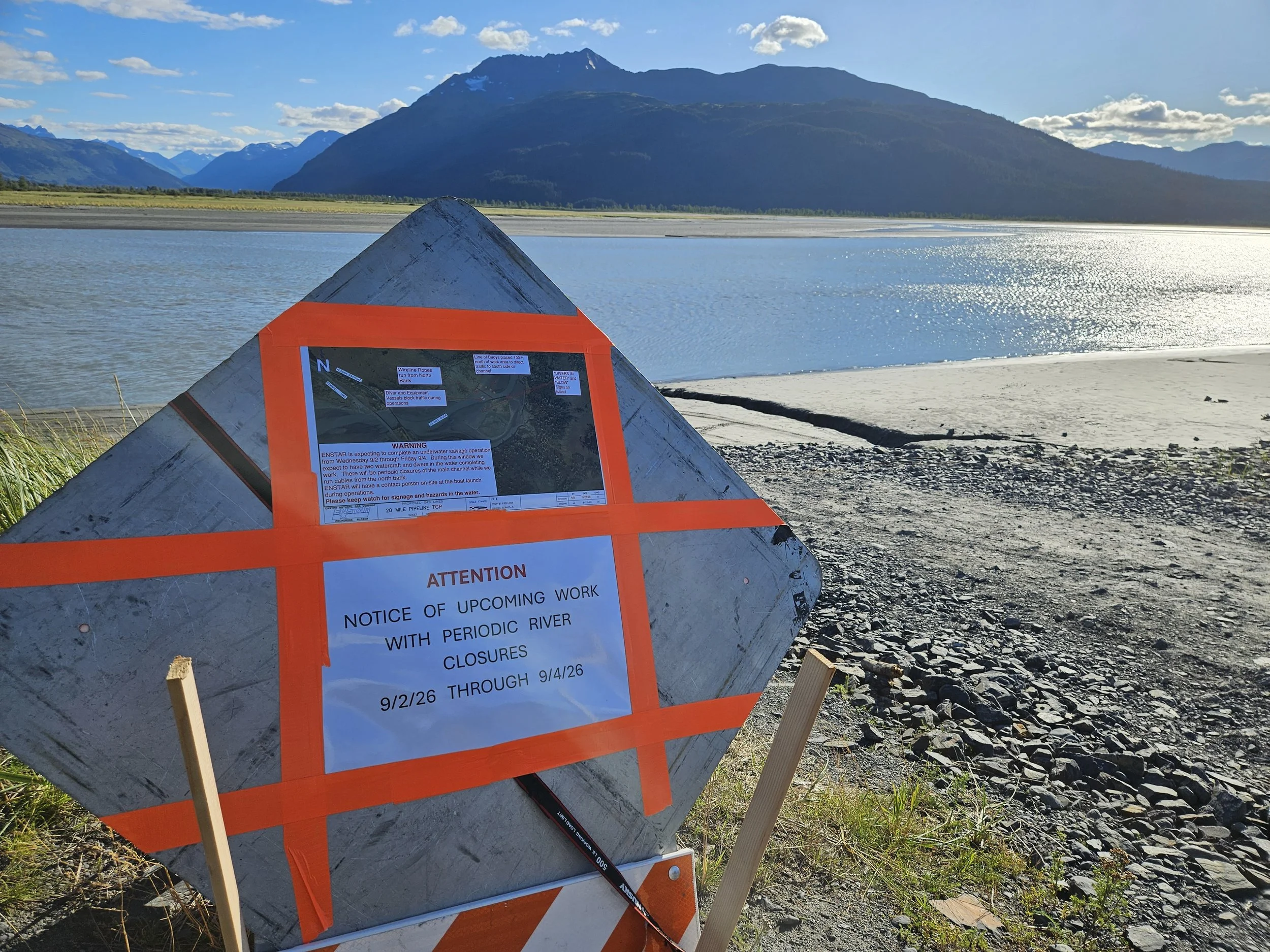
The sign at the Twentymile River boat ramp warning of upcoming “underwater salvage” activities and river closures, as seen on Saturday, August 29th. (Photo by Chase Berenson)
The costs of the temporary LNG and the pipeline repair are not yet known according to Hedlund. When the costs are calculated, they will be shared among all Enstar’s ratepayers and not just the impacted customers in Whittier.
Hedlund said utility interruptions can occur for many reasons, including severe weather and earthquakes, so Enstar, “encourages customers to maintain an emergency plan and supplies for unexpected disruptions.”
This echoes Anchorage’s Office of Emergency Management, which has suggested emergency plans and emergency supply kits on its website. If there is a natural gas interruption of any cause, Hedlund encourages customers to follow Enstar instructions and never to unlock a natural gas meter.
Cooper wrote, in 2023, “Enstar is proud of our system-wide 99.99% reliability rate."
Hedlund echoed this sentiment and pointed out that, “the Twentymile River rupture is an unusual event.”
“Enstar operates more than 3,000 miles of pipeline throughout Southcentral Alaska and takes the safety and reliability of its system seriously,” she said.